

A few months ago, I was pulling out of my driveway to bring my son to school, and I felt an impression on my heart that God was saying, “Someone is going to run a red light today.” Suddenly my spirit was alert and paying close attention to my surroundings as I drove. When I stopped at the stop sign before turning onto the school’s street, a car ran the stop sign right in front of me. Had I not stopped for a moment and paid attention, that car would have hit my son’s side of the car head-on.
A great deal of suffering was prevented that day by the Spirit of Lord leading me. Someone else’s mistake could have caused injury or death to me or my son. Often times, our suffering is caused by other people, but it is just as often caused by our own sin—the culmination of a fallen, broken world.
In the Beginning…
Such has been the case since the Garden of Eden when sin entered the world. Suffering was then deemed to be the consequence of sin. In Genesis 3 after Adam and Eve had disobeyed God, He told Adam, “Getting food from the ground will be as painful as having babies is for your wife; you’ll be working in pain all your life long” (Genesis 3:17 MSG).
And thus, suffering became a part of our lives just as much as breathing. A friend recently made a comment to me that because suffering has been unabated before or since Jesus came into the world, it is difficult to trust a God who allows it to continue. I’ve been reading Eugene Peterson’s A Long Obedience in the Same Direction, which I believe poses an important point in that regard:
Ivan Illich, in a recent interview, said: “You know, there is an American myth that denies suffering and the sense of pain. It acts as if they should not be, and hence it devalues the experience of suffering. But this myth denies our encounter with reality.” The gospel offers a different view of suffering: in suffering we enter the depths; we are at the heart of things; we are near to where Christ was on the cross.
Peterson, Eugene. A Long Obedience in the Same Direction. Downers Grove, IL: Intervarsity Press, 1980, pg. 134.
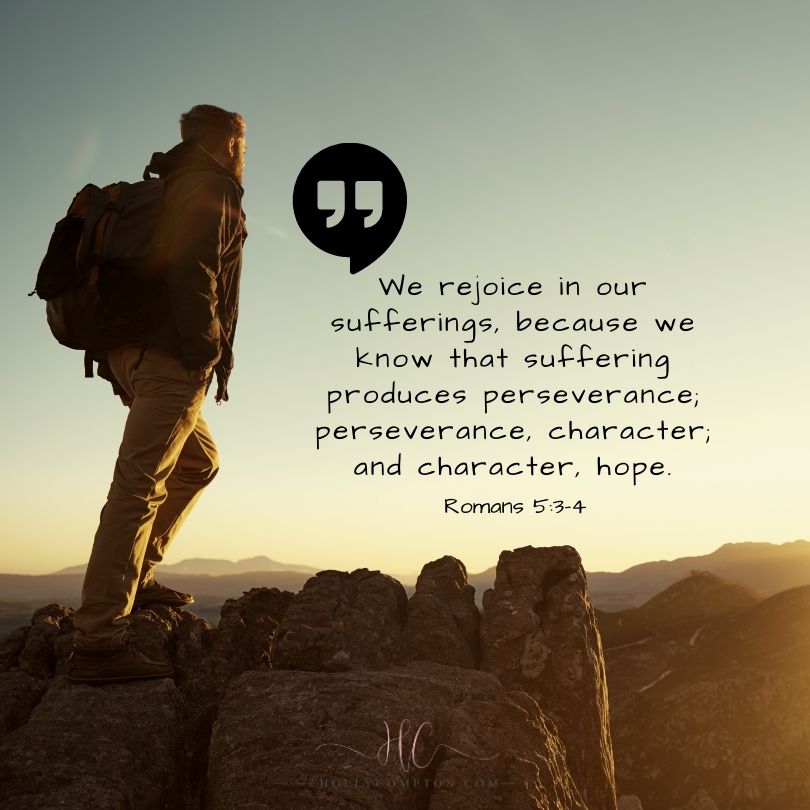
Even the Son of God Himself when He became flesh did not avoid suffering but embraced it on the cross. He did it with joy knowing that His sacrifice of suffering would allow us an eternity with Him in a perfect, pain and tear-free heaven. The Apostle Paul maintained that there is joy in suffering: “[With joy] let us exult in our sufferings and rejoice in our hardships, knowing that hardship (distress, pressure, trouble) produces patient endurance; and endurance, proven character (spiritual maturity); and proven character, hope and confident assurance [of eternal salvation]” (Romans 5:3-4 AMP).
But Where is God?
God is not indifferent to our pain as we endure it, however. While it may produce blessings in our life and a promised heavenly result, pain is still pain-full at the time. Suffering is by definition an unpleasant experience produced by our harm or threat of harm. But we do not suffer alone, although we might feel that way: “He comforts us whenever we suffer. That is why whenever other people suffer, we are able to comfort them by using the same comfort we have received from God” (1 Corinthians 1:4 GW).
Yes, suffering exists in this world, but God is compassionate and sympathetic to hear our cries; He dries our tears and reminds us that the pain is not the endgame. We see all kinds of examples around us in nature and in others’ lives where pain and suffering are mere stepping stones for a beautiful result, like in the creation of a diamond. Something exquisite and of great value comes forth out of hardship and pressure.
And this, of course, is why we are able to face, acknowledge, accept and live through suffering, for we know that it can never be ultimate, it can never constitute the bottom line. God is at the foundation and God is at the boundaries.
Peterson, Eugene. A Long Obedience in the Same Direction. Downers Grove, IL: Intervarsity Press, 1980, pg. 136.
And God does help and protect us from harm at times, as He did that day when the car ran the stop sign. The Psalms are filled with evidence of this: “He will cover you and completely protect you with His feathers, and under His wings you will find refuge; His faithfulness is a shield and a wall” (Psalm 91:4 AMP). We may not always be aware of His protection, but He is ever-present working all things together for the good of those who trust in Him (Romans 8:28).
So What?
We cannot place blame on God that so much suffering remains in the world. We, in ourselves, and others who make poor choices in life are at fault in many ways. And why, we ask, is there famine? Car accidents? Wars? Orphans? Tornados? Earthquakes? Any tragedies at all? The physical world is, indeed, fallen and broken, and human choices over thousands of years are at the core.
But Jesus did not abandon us to endure the torment on our own: “I have told you these things, so that in Me you may have [perfect] peace. In the world you have tribulation and distress and suffering, but be courageous [be confident, be undaunted, be filled with joy]; I have overcome the world. [My conquest is accomplished, My victory abiding.]” (John 16:33 AMP).
That’s why Jesus came into the world: to overcome it. That’s why we can, with childlike faith, trust in His victory: suffering and death are never the end. God always has the last word. And it’s not over yet.
 The Art of Choosing True Life