
This week I finished reading a book called Get Out of Your Head, by Jennie Allen. While I have long been bullied by the lies of the enemy in my thought life, I have also been speaking Truth as much as possible over myself and my family to keep the enemy at bay. I decided to read this book to help us in our spiritual battle, and the book more than delivered.
The most powerful chapter for me, however, came not in regards to a negative thought, but to a “positive” one that I wouldn’t have necessarily noticed: “I am enough.” The enemy wants us to believe this lie, that we are “enough” as we are: enough without God, enough to face life alone, enough to be and do anything we want. But the Truth of the matter is that we are not enough without God! But with God, we are more than conquerors! We were not made to face life alone, but to do so in community. We are not enough to be and do anything we want to—we were made to be and do only that which God has purposed us to!
Understanding this concept, that by ourselves we are not enough, requires humility. In the book Jennie talks through the definition of humility and how it applies here:
I can’t conjure humility myself. Humility comes only when I choose to be with Him and depend on Him instead of buying the lie that I am enough. A favorite Bible dictionary of mine defines humility this way: “A condition of lowliness or affliction in which one experiences a loss of power or prestige.” …Outside of biblical faith, humility would be lunacy. Who wants less power, less prestige? But within biblical faith, it is virtuous, this utter dependence on God. …Our hearts aren’t really after power; they’re after joy. …Joy comes when we put the emphasis where it belongs: on God’s awesomeness, not our own. …Oh, that you and I would align our thoughts not so our lives would say “Look at me” but so everything about us would declare “Look at You, Jesus!”
Allen, Jennie. Get Out of Your Head. (Colorado Springs: Waterbrook, 2020), p. 162-163.
I find that I can only truly find humility as I spend time with God confessing that utter dependence on Him and giving Him the honor that He is rightfully due. But even then, my flesh cries out that I don’t want to see my puniness compared to Him; I still want to say “I am enough” in some measure. That’s because I don’t want to fully realize, accept and “glory in” my weakest places the way that Paul wrote about. Jennie also quotes Andrew Murray to explain this:
Every Christian virtually passes through these two stages in his pursuit of humility. In the first he fears and flees and seeks deliverance from all that can humble him. …He prays for humility, at times very earnestly; but in his secret heart he prays more, if not in word, then in wish, to be kept from the very things that will make him humble. …It has not yet become his joy and only pleasure. He cannot yet say, “Most gladly do I glory in weakness, I take pleasure in whatever humbles me.” But can we hope to reach the stage in which this will be the case? Undoubtedly. And what will it be that brings us there? That which brought Paul there—a new revelation of the Lord Jesus.
Murray, Andrew. Humility: The Beauty of Holiness, 2nd ed. (London: James Nesbit, 1896), p. 81.
Take pleasure in what humbles me? I’m not there yet. My struggle with my weight has kept me humble throughout my entire life, but I’m not sure that I can say this struggle has brought me joy. I think we often gloss over the fact that Paul says he “takes glory” in his weakness because we want to get to the part where he says it’s because God’s grace is sufficient, that His power is made perfect in Paul’s weakness (2 Corinthians 12:9). We don’t realize that Paul is actually joyful and thankful for his weakness.
No, Lord, I really don’t like feeling weak! No, I don’t want to keep feeling weak in this area. I want to feel strong, I want to feel like I’m enough to overcome this struggle on my own. But I don’t, and I can’t. If I’m going to let God get down to the real heart issue behind my weight struggle, this is where humility must take over.
What humbles me, really humbles me! It hurts, God! It stabs my pride in the back and brings me to my knees! But that’s what You want, Lord. That was Your plan, wasn’t it? In order to show me that I am not enough unless I depend fully on You and Your strength.
In Lysa TerKeurst’s book Made to Crave Devotional, she shares the same struggle and how we make that leap of faith from pain to pleasuring in our weakness:
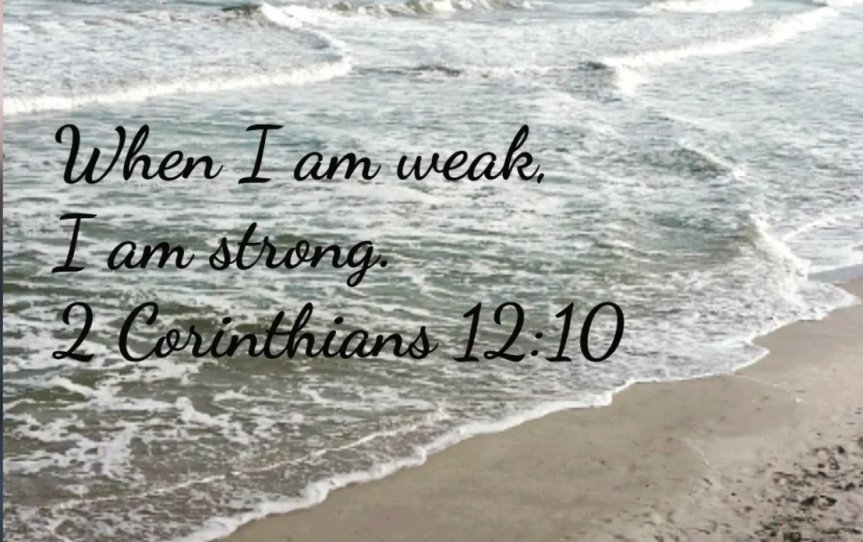
Maybe we need to sit still for just a moment or two today. Quiet, without the weight of condemnation or the swirl of trying to figure things out. Quiet, with nothing but the absolute assurance the Spirit helps us in our weakness. The Spirit knows what to pray. He understands our weak places. There is a purpose to this weak place. Though it doesn’t feel good now, things will be worked out in a way that good will come from it (Romans 8:28). …Instead of wallowing in my weak place, I will let the Spirit reveal the one positive step I can take today. I will wash away the condemnation with the warmth of His grace. I will receive His power. And I will rename the weakness my strong place. “For when I am weak, then I am strong” (2 Corinthians 12:10b).
TerKeurst, Lysa. Made to Crave Devotional. (Nashville: Nelson Books, 2011), p. 147-148.
I might not feel joy over this struggle, which is okay for now; our feelings do not determine the truth. What is true is that God uses all things together for good, and the good that has come of my own weight struggle is the compassion and mercy I feel for everyone else with the same struggle! There is never any judgement passed on others who have a similar weak place, and God uses me to encourage others to get healthy too.
I do believe that our weak places are a gift from God, ensuring our humility and dependence on Him. If we were perfect, why would we need God? More than anything, our weaknesses should be an arrow pointing to heaven, like Jennie wrote, so that our lives don’t shine a bright light on our own greatness and strength. Instead, they point to God’s strong place saying, “Look at You, Jesus!”
 The Art of Choosing True Life